
Choosing the right laptop in today’s market is no longer a straightforward task. The modern laptop ecosystem is crowded with devices that appear similar at first glance yet deliver vastly different experiences once used in real-world conditions. From professional work and creative production to casual use and high-performance gaming, laptops are now expected to handle a wide range of tasks. In our experience, many buyers underestimate how significantly these expectations should influence their purchasing decision. As a result, they often end up with a machine that looks impressive on paper but fails to meet their daily needs.
One of the main reasons this decision has become so complex is the sheer volume of choices available. Manufacturers release multiple models each year with overlapping specifications, subtle design differences, and marketing-driven feature highlights. By our research, it is common for users to feel overwhelmed by technical terms and promotional claims, leading them to make rushed or poorly informed decisions. Whether you are a student, a professional, a content creator, or a gamer, choosing the wrong laptop can cost you productivity, money, and long-term satisfaction.
Based on our experience and extensive testing, the most common mistake buyers make is focusing on a single specification in isolation. Many people prioritize processor speed, graphics performance, or brand reputation while ignoring equally important factors such as thermal management, battery efficiency, build quality, and long-term reliability. In our opinion, a laptop should be evaluated as a complete system rather than a collection of individual components. A powerful processor paired with poor cooling or inadequate battery life can quickly become a source of frustration.
Another critical oversight we often observe is failing to consider how usage patterns evolve over time. A laptop purchased for basic tasks today may struggle to keep up with future software updates, heavier workloads, or new use cases. By our research, users involved in activities such as video editing, programming, gaming, or working with modern development tools—including environments built using low-code or no-code platforms—often underestimate how quickly system requirements can grow. Future-proofing, therefore, is not about buying the most expensive model, but about choosing balanced hardware that can adapt over several years.
In our opinion, the best laptop is not defined by price or brand alone. It is the machine that aligns precisely with how you plan to use it on a daily basis. Portability matters if you travel frequently, while thermal performance and upgradeability are crucial for power users. Gamers require different priorities than office professionals, and creative users have entirely separate demands related to display quality and processing power. Ignoring these distinctions often leads to disappointment.
This in-depth guide breaks down nine powerful factors you must understand before purchasing a laptop for work or gaming. The objective is not to push specifications, but to help you make a confident, informed, and future-ready decision. By focusing on real-world performance, usability, and longevity, this guide aims to ensure that your investment delivers consistent value for years to come—not just impressive numbers on a product listing.
Table of Contents
1. Define Your Primary Use Case (Work, Gaming, or Both)
Before comparing specifications, benchmarks, or brand names, the most critical step in choosing the right laptop is clearly defining your primary use case. In our experience, many users end up dissatisfied not because the laptop is “bad,” but because it was never aligned with their real, day-to-day needs. Being honest about how you will actually use the device—rather than how you wish you would use it—leads to a far better long-term decision.
Laptops for Work
Work-focused laptops are designed with consistency and efficiency in mind rather than brute power. From our research, these machines prioritize stability, long battery life, and a comfortable user experience over flashy specifications. A responsive keyboard, an eye-friendly display, and quiet operation matter far more during long working hours than raw performance numbers.
Such laptops are ideal for office productivity, programming, content writing, research, online meetings, and even light photo or video editing. In our opinion, professionals working with documents, browsers, development tools, or Low-code and No-code platforms benefit more from reliability and endurance than from high-end graphics. By our experience, a laptop that lasts all day without thermal throttling or fan noise significantly improves productivity and reduces fatigue.
Laptops for Gaming
Gaming laptops are built with a completely different philosophy. They focus on raw performance, featuring powerful multi-core processors, dedicated graphics cards, advanced cooling systems, and high refresh rate displays. These machines are designed to handle demanding workloads such as AAA gaming titles, game streaming, 3D rendering, and heavy video editing.
By our research, gaming laptops sacrifice portability and battery life to deliver sustained performance under load. In real-world usage, they are louder, heavier, and consume more power—but they excel when performance is the top priority. For creators working with animation, simulations, or intensive design workflows, this performance advantage can be crucial.
Hybrid Users
Hybrid users—those who work by day and game by night—require a balanced approach. In our opinion, this is the most challenging category because it demands compromises. A strong CPU, a dedicated GPU, effective thermal management, and acceptable battery life must coexist in one system.
From our experience, ultra-thin laptops often fail in this role due to limited cooling and sustained performance issues. By our research, performance-oriented laptops with proper airflow offer better long-term value for hybrid users, especially those experimenting with development tools, creative software, or modern No-code workflows alongside gaming. Choosing balance over extremes ensures the laptop remains capable, comfortable, and reliable for years to come.
2. Processor (CPU): The Core of Performance
The processor is the true foundation of a laptop’s performance, influencing everything from basic responsiveness to demanding workloads. In our opinion, no other component impacts the overall user experience as consistently as the CPU. Whether you are working, gaming, or doing a mix of both, the processor determines how smoothly tasks are executed and how well the system holds up over time.
CPU Requirements For Work
For work-oriented usage, a modern multi-core processor is essential. By our experience, users who rely on productivity tools, browsers with multiple tabs, coding environments, or Low-code and No-code platforms quickly notice slowdowns on older or low-core CPUs. A capable processor ensures faster multitasking, smooth switching between applications, and efficient handling of background processes such as system updates or cloud syncing.
- Faster multitasking
- Smooth application switching
- Efficient background processes
From our research, a quad-core processor or higher with the latest generation architecture should be considered the minimum baseline for professional use today. Newer architectures are more power-efficient and better optimized for modern software, which translates into improved battery life and consistent performance during long work sessions. In real-world scenarios, this means fewer freezes, quicker load times, and a more responsive system overall.
- Quad-core or higher
- Latest generation architecture
CPU Requirements For Gaming
Gaming places a different type of demand on the processor. While graphics cards often get most of the attention, the CPU plays a critical role in game logic, physics calculations, and frame consistency. By our experience, games benefit significantly from higher clock speeds and strong single-core performance, especially competitive or open-world titles.
- Higher clock speeds
- Strong single-core performance
- CPU-GPU balance
However, raw CPU power alone is not enough. In our opinion, balance between the CPU and GPU is far more important than chasing the highest numbers. Pairing a high-end processor with a weak graphics card often results in a performance bottleneck, where the system cannot fully utilize its processing potential. By our research, well-matched components deliver smoother gameplay and more stable frame rates than mismatched high-end parts.
Expert Insight
One key lesson we have learned is to prioritize newer-generation processors over older high-end models. Architectural improvements, better instruction sets, and improved efficiency often allow modern mid-range CPUs to outperform older chips with higher clock speeds. This approach is especially practical for users working with evolving technologies, including Low-code and No-code tools, where efficiency and responsiveness matter more than outdated raw power.
3. Graphics Card (GPU): Integrated vs Dedicated
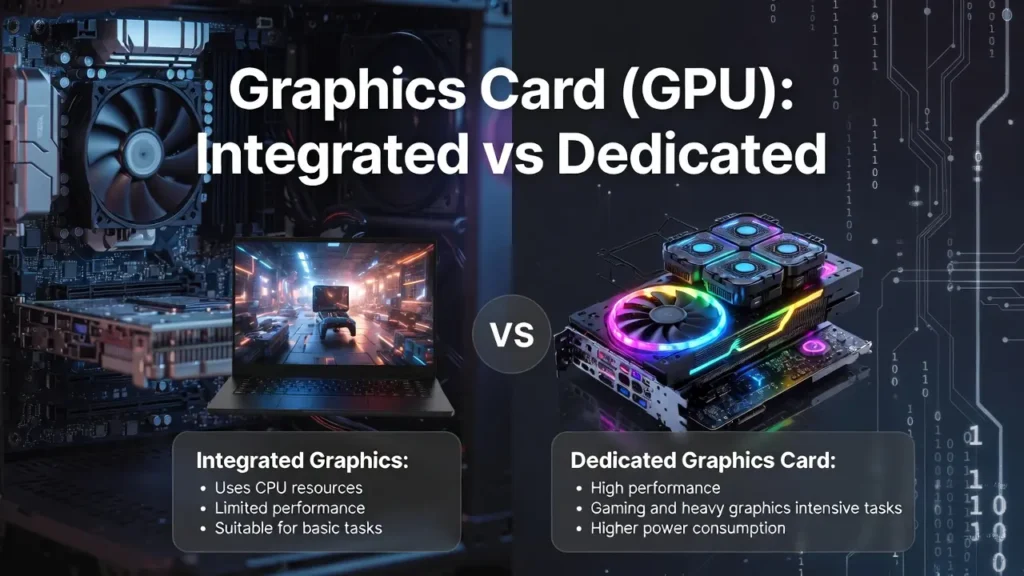
The graphics card plays a decisive role in determining how well a laptop handles visuals, rendering tasks, and performance-intensive applications. In our opinion, the GPU is often misunderstood, with many users either underestimating its importance or overpaying for power they may never fully use. Understanding the difference between integrated and dedicated graphics is essential for making a practical and future-proof choice.
Integrated Graphics
Integrated graphics are built directly into the processor and share system memory. By our experience, they are more than sufficient for everyday computing tasks such as office work, web browsing, media consumption, and light creative workloads. Modern integrated GPUs have improved significantly in recent years and can comfortably handle high-resolution video playback, basic photo editing, and UI-heavy applications.
From our research, integrated graphics are especially well-suited for professionals using productivity software, cloud-based tools, and Low-code or No-code platforms. These workloads prioritize responsiveness and stability over graphical horsepower. Another major advantage is efficiency. Integrated GPUs consume less power, generate minimal heat, and help extend battery life, making them ideal for users who work on the go or attend long meetings without constant access to charging.
Dedicated Graphics
Dedicated graphics cards, on the other hand, are designed for performance-heavy tasks. They come with their own video memory and processing cores, allowing them to handle complex graphical computations independently. By our experience, dedicated GPUs are essential for gaming, video editing, 3D modeling, animation, and emerging fields such as AI and machine learning.
However, this performance comes with trade-offs. In our opinion, users must be aware that dedicated GPUs significantly increase heat output, reduce battery life, and add weight to the laptop. From our research, systems with dedicated graphics also require more advanced cooling solutions, which can result in louder fan noise during intensive workloads.
- Increase heat
- Reduce battery life
- Add weight
Practical Recommendation
Based on our experience, if gaming is more than an occasional activity, a dedicated GPU is not optional—it is mandatory. Casual or cloud-based tasks may run on integrated graphics, but consistent gaming or creative workloads demand dedicated hardware. In our opinion, choosing the right GPU should align with your actual usage patterns, ensuring a balance between performance, portability, and long-term reliability rather than chasing unnecessary specifications.
4. RAM: Multitasking Without Slowdowns
RAM is one of the most critical yet often overlooked components of a laptop. It directly determines how smoothly your system can handle multiple tasks at the same time. In our opinion, insufficient RAM is one of the most common reasons laptops feel slow, even when they have a capable processor. By our experience, users usually notice RAM limitations when switching between applications, opening multiple browser tabs, or running background processes alongside active work.
Minimum Recommendations
- 8GB RAM: From our research and real-world usage, 8GB of RAM is the bare minimum for basic workloads. It can handle everyday tasks such as document editing, browsing, video streaming, and light gaming. However, by our experience, this amount quickly becomes restrictive once multitasking increases or when modern applications demand more memory.
- 16GB RAM: For professional work and modern games, 16GB of RAM offers a much smoother and more reliable experience. In our opinion, this is the current sweet spot for most users. It allows seamless multitasking, stable performance during long sessions, and better handling of development environments, creative software, and Low-code or No-code platforms that rely heavily on browser-based tools and background services.
- 32GB RAM: For advanced users, 32GB of RAM is ideal for heavy video editing, large-scale development, virtualization, and future-proofing. By our research, while not everyone needs this much memory today, it significantly extends the usable lifespan of a laptop as software requirements continue to grow.
In our opinion, 16GB RAM is the current sweet spot for both work and gaming users.
Why Upgradeability Matters
Beyond the amount of RAM, upgradeability is equally important. In our experience, many users regret purchasing laptops with non-upgradable memory. Always check whether the RAM is expandable, how many memory slots are available, and the maximum supported capacity. These details determine how flexible your system will be in the future.
Soldered RAM, while common in ultra-thin designs, severely limits upgrade options. In our opinion, it should be avoided whenever possible, especially for users planning long-term use. By our research, laptops with accessible memory slots offer better value, adaptability, and longevity, ensuring your system can evolve alongside changing workloads, including emerging No-code and Low-code development trends.
5. Storage Type and Capacity: Speed vs Space
Storage plays a major role in determining how fast and responsive a laptop feels in everyday use. In our opinion, storage speed often has a more noticeable impact on user experience than raw processing power. By our experience, even a powerful laptop can feel slow and unresponsive if it relies on outdated storage technology. Boot times, application loading, file transfers, and system updates are all directly affected by the type and capacity of storage you choose.
SSD vs HDD
- SSD: Solid-state drives (SSDs), are faster, quieter, and far more reliable. In our experience, switching from an HDD to an SSD can make an older laptop feel dramatically faster. SSDs have no moving components, which improves durability and reduces power consumption—an important factor for battery life. For modern laptops, an SSD is non-negotiable, regardless of whether the system is used for work, gaming, or creative tasks.
- HDD: Traditional hard disk drives (HDDs) are now largely outdated for modern laptops. They are slower, heavier, generate more heat, and are more prone to physical failure due to their moving parts. By our research, laptops equipped with HDDs struggle with basic responsiveness and significantly longer boot and load times.
For modern laptops, SSD is non-negotiable.
Recommended Configuration
- 512GB SSD: From our research, a 512GB SSD should be considered the minimum for professional work. Operating systems, applications, updates, and cached files consume space quickly, especially when working with browsers, development tools, or Low-code and No-code platforms that rely on local storage and temporary files.
- 1TB SSD: For gaming, content creation, or media-heavy workflows, a 1TB SSD is far more practical. Games, high-resolution videos, and project files can occupy hundreds of gigabytes, and running out of storage negatively impacts performance and productivity.
NVMe vs SATA SSDs
In our opinion, not all SSDs are equal. NVMe SSDs deliver noticeably faster read and write speeds compared to older SATA-based drives. By our experience, NVMe storage results in quicker boot times, faster file transfers, and smoother overall system behavior. For users seeking speed, reliability, and long-term value, NVMe SSDs are the preferred choice.
6. Display Quality: More Than Just Size
A laptop display is one of the most important components affecting daily comfort, productivity, and overall satisfaction. In our opinion, the display is the part of the laptop you interact with the most, yet it is often overlooked in favor of internal specifications. By our experience, even a powerful machine can feel unpleasant to use if the screen quality is poor. Whether you are working long hours or gaming during free time, the display plays a direct role in how enjoyable and sustainable that experience is.
Key Display Factors
From our research, resolution should never drop below Full HD (1920×1080). This level of sharpness ensures clear text, detailed visuals, and adequate workspace for multitasking. Lower resolutions can cause visible pixelation, especially on larger screens, which leads to eye fatigue over time.
Panel type is equally critical. IPS panels are preferred because they offer better color accuracy and wider viewing angles compared to older technologies. By our experience, IPS displays maintain consistent colors even when viewed from different angles, which is especially important for collaborative work or creative tasks. Brightness is another key factor. A minimum of 300 nits ensures comfortable visibility in well-lit rooms and reduces the need to strain your eyes. Color accuracy also matters more than many users realize, particularly for content creation, design work, and modern web-based tools, including Low-code and No-code platforms that rely on clear UI elements and visual clarity.
Display Needs For Work
For professional use, the focus should be on clarity and comfort. In our opinion, sharp text rendering makes a noticeable difference during long writing, coding, or research sessions. Accurate color reproduction helps maintain visual consistency, while an anti-glare coating reduces reflections and eye strain. By our experience, these features collectively improve concentration and allow users to work for extended periods without discomfort.
Display Needs For Gaming
Gaming places different demands on a display. High refresh rates, typically 120Hz or higher, result in smoother motion and more responsive gameplay. Low response times help reduce motion blur and ghosting, improving overall immersion. By our research, these factors significantly enhance fast-paced games and competitive titles.
Real-World Impact
In real-world usage, a high-quality display reduces eye strain, improves focus, and enhances immersion. By our experience, investing in a good screen pays off every single day, making long working sessions and extended gaming far more comfortable and enjoyable.
7. Battery Life and Power Efficiency
Battery life is one of the most practical factors in choosing a laptop, yet it is also one of the most misunderstood. In our opinion, advertised battery figures rarely reflect real-world usage. By our experience, how long a laptop actually lasts on a single charge depends heavily on its hardware configuration, usage pattern, and power optimization. This is why battery expectations differ significantly between work-focused and gaming-oriented laptops.
Battery Life in Work Laptops
Work laptops are typically designed with efficiency as a priority. From our research, achieving 8 to 12 hours of battery life is realistic on well-optimized systems under normal workloads. These laptops rely on energy-efficient processors, integrated graphics, and smart power management to extend usage time. In real-world scenarios, this translates to a full workday of tasks such as document editing, browsing, online meetings, coding, and working on cloud-based tools, including Low-code and No-code platforms.
By our experience, features like adaptive brightness, low-power display panels, and efficient background process management contribute significantly to longer battery life. In our opinion, for professionals who travel, attend meetings, or work remotely, consistent battery endurance is more valuable than peak performance. A laptop that lasts all day without constant charging offers flexibility and reduces dependence on power outlets.
Battery Life in Gaming Laptops
Gaming laptops follow a completely different design philosophy. They are built for maximum performance rather than efficiency. Dedicated graphics cards, high-refresh-rate displays, and powerful processors consume significantly more power. By our research, 3 to 6 hours of battery life is typical for gaming laptops during light usage, and far less when gaming on battery.
In our experience, these systems are intended to be used while plugged in, allowing them to deliver full performance without power limitations. Battery mode often restricts performance to preserve charge, which can reduce gaming capability. In our opinion, expecting long battery life from a gaming laptop leads to disappointment if the system is not used as intended.
Practical Recommendations
Our recommendation is to prioritize fast charging and USB-C power delivery if mobility matters. By our experience, fast charging can restore a large percentage of battery life in a short time, making it easier to stay productive between sessions. USB-C charging adds flexibility, allowing users to carry a single charger for multiple devices. From our research, these features significantly improve real-world usability, especially for hybrid users balancing performance and portability.
8. Build Quality, Keyboard, and Port Selection
Build quality, keyboard comfort, and port selection directly affect how enjoyable and reliable a laptop feels in daily use. In our opinion, these elements are just as important as internal specifications, especially for users who spend long hours working on their devices. By our experience, laptops with poor construction or uncomfortable input devices quickly become frustrating, regardless of how powerful they are on paper.
Build Quality
A solid build ensures durability and long-term reliability. From our research, laptops with metal chassis tend to last longer than plastic-built alternatives. Metal construction offers better structural integrity, improved hinge stability, and greater resistance to wear and tear over time. In real-world usage, this means fewer creaks, less flex, and a more premium feel that holds up after years of use.
By our experience, better build quality also contributes to improved heat dissipation. Metal surfaces help spread heat more efficiently, allowing internal components to maintain stable performance. In our opinion, this is especially valuable for users running demanding workloads, development tools, or modern Low-code and No-code platforms that rely on sustained performance.
Keyboard & Trackpad
For work-focused users, the keyboard is a critical interface. In our opinion, good key travel and a comfortable layout significantly reduce typing fatigue during long sessions. By our experience, well-spaced keys with consistent feedback improve typing accuracy and speed. Backlit keys are also important, particularly for those who work in low-light environments or during late hours.
The trackpad should be precise, responsive, and large enough to support modern gestures. From our research, a high-quality trackpad enhances productivity by reducing reliance on external peripherals.
Ports
Port availability is often overlooked but extremely important. Ensure the laptop includes essential ports such as USB-A, USB-C, HDMI, and an audio jack. By our experience, excessive dongle dependency is inconvenient and unnecessary. In our opinion, a well-balanced port selection improves flexibility, simplifies connectivity, and enhances the overall daily user experience.
Dongle dependency is inconvenient and avoidable.
9. Cooling System and Thermal Performance
The cooling system is one of the most underestimated aspects of a laptop, yet it plays a critical role in real-world performance and long-term reliability. In our opinion, thermal design often determines whether a laptop can actually deliver the performance promised on its specification sheet. By our experience, many users focus heavily on CPU and GPU specifications while completely overlooking how well the system can manage heat under sustained workloads.
Why Cooling Matters
Effective cooling prevents performance throttling, which occurs when internal components reduce their speed to avoid overheating. From our research, laptops with inadequate thermal solutions may initially perform well but quickly slow down during prolonged use. This is especially noticeable during tasks such as gaming, video rendering, software development, or extended sessions on Low-code and No-code platforms that keep the processor under continuous load.
Good thermal management also extends component lifespan. Excessive heat is one of the primary causes of hardware degradation over time. By our experience, laptops that consistently run hot are more likely to suffer from reduced battery health, unstable performance, and premature component failure. In our opinion, stable temperatures directly translate into better long-term value and reliability.
Real-World Performance vs Specifications
From our experience, some laptops advertise high-end processors and graphics but fail to deliver sustained performance due to weak thermal design. In our opinion, raw specifications mean little if the system cannot maintain them under load. This is why reviewing real-world thermal performance is essential.
Always look beyond spec sheets and marketing claims. By our research, user reviews and stress-test results provide better insight into how a laptop performs over time. A well-cooled laptop ensures consistent performance, lower noise, and greater durability, making thermal design a key factor in any informed buying decision.
Common Mistakes to Avoid When Buying a Laptop
- Overpaying for unused features
- Ignoring upgrade options
- Choosing looks over cooling
- Underestimating storage needs
- Buying outdated hardware at a discount
Smart buyers think long-term, not just at checkout.
Final Buying Checklist (Quick Summary)
- Clear use case defined
- Latest-generation CPU
- Balanced GPU choice
- Minimum 16GB RAM
- SSD storage (512GB or more)
- Quality display
- Reliable battery life
- Strong cooling system
Conclusion: Make a Smart, Future-Proof Choice
Choosing the best laptop for work or gaming is about balance, not hype. In our opinion, the ideal laptop is one that fits your workflow today while remaining capable tomorrow. Based on real-world usage and long-term testing insights, prioritizing performance consistency, upgradability, and thermal efficiency will deliver the best value.
A well-chosen laptop becomes a productivity partner—not a limitation. Take the time to evaluate these nine factors carefully, and you will avoid buyer’s remorse while maximizing performance for years to come.
Frequently Asked Questions (FAQs)
1. Can a gaming laptop be used for work?
Yes. Gaming laptops are powerful and handle professional tasks easily, though battery life may be shorter.
2. Is 16GB RAM enough for gaming and work?
Yes. For most users, 16GB RAM offers the best balance of performance and cost.
3. Are thin laptops good for gaming?
Generally no. Thin laptops struggle with cooling and sustained performance.
4. Should I prioritize CPU or GPU for gaming?
GPU first, but ensure the CPU is strong enough to avoid bottlenecks.
5. How long should a good laptop last?
With proper care, a quality laptop should last 4–6 years comfortably.
Informative …it would be helpful
Thanks for your Precious Feedback