
Gaming in 2026 has evolved far beyond the old debate of keyboard versus controller. Today, choosing between PC gaming and console gaming is a decision influenced by performance scalability, ecosystem flexibility, long-term costs, and how deeply you want to engage with your games. With rapid improvements in hardware efficiency, AI-assisted graphics optimization, cloud gaming services, and cross-platform play, the gap between PC and console gaming has both narrowed and expanded in different ways.
From our experience working closely with gamers, developers, and tech communities across multiple regions, one reality stands out clearly: there is no single “best” gaming platform for everyone. What works perfectly for a competitive esports player may feel limiting to a casual living-room gamer. Similarly, what excites a tech enthusiast who loves tweaking hardware settings might overwhelm someone who simply wants to plug in a device and start playing.
By our research and hands-on testing, the modern gaming ecosystem is shaped by more than raw specifications. Factors such as upgrade freedom, exclusive titles, backward compatibility, subscription services, and even energy efficiency now play a major role in the decision-making process. Consoles have become smarter, quieter, and more user-friendly, while PCs continue to push boundaries in customization, modding, and ultra-high-end performance. At the same time, emerging trends like cloud-based gaming workflows—often inspired by Low-code and No-code philosophies—are changing how games are optimized and delivered behind the scenes, further blurring traditional platform lines.
In our opinion, the real question in 2026 is not which platform is more powerful, but rather which platform aligns with your gaming habits, budget expectations, and future plans. Are you looking for maximum visual fidelity and control, or a streamlined, stress-free gaming experience? Do you value exclusive franchises, or do you prioritize long-term flexibility and hardware longevity?
This in-depth guide breaks down 7 powerful differences between PC and console gaming in 2026, covering performance, cost, exclusives, customization, ecosystem strength, lifespan, and overall value. Our goal is to help you make an informed, practical decision—one that genuinely fits your playstyle today and remains relevant for years to come.
Table of Contents
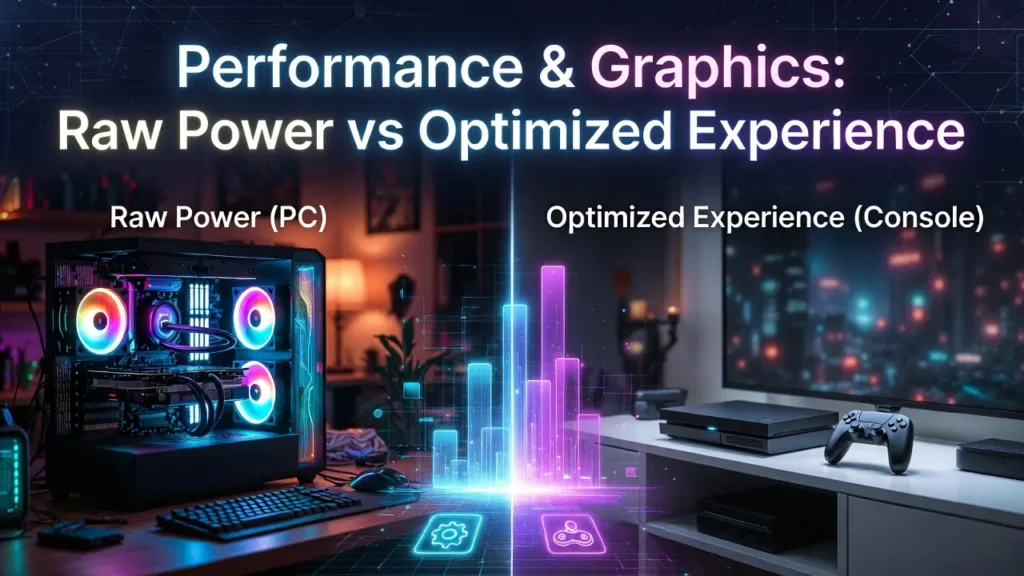
1. Performance & Graphics: Raw Power vs Optimized Experience
When it comes to performance and visual quality in 2026, the difference between PC and console gaming is no longer about which one is better, but rather how that performance is delivered. Based on our experience analyzing modern gaming setups and player preferences, this distinction plays a major role in long-term satisfaction.
PC Gaming Performance in 2026
PC gaming continues to lead in raw performance potential. With support for high-end GPUs, multi-core CPUs, faster RAM, and advanced cooling, PCs can push:
- Higher frame rates (144Hz, 240Hz, and beyond)
- Ultra-wide and multi-monitor setups
- Advanced ray tracing and AI upscaling
- Full control over graphics presets
From our research and hands-on testing, PC gamers also benefit from unmatched display freedom. Ultra-wide monitors, multi-monitor setups, and custom resolutions provide a level of immersion that consoles simply cannot replicate. Advanced features such as real-time ray tracing, AI-driven upscaling, and granular control over texture quality, shadows, and lighting give players full authority over how their games look and perform.
In our opinion, this level of control is the main reason visual enthusiasts and performance-focused players gravitate toward PCs. However, this power comes with responsibility. Performance heavily depends on correct hardware pairing, driver updates, and system optimization. A poorly configured PC or outdated component can create bottlenecks that limit real-world performance, even on expensive setups.
Console Gaming Performance in 2026
Modern consoles prioritize consistency and optimization. Developers design games specifically for a fixed hardware target, which means:
- Stable frame pacing
- Optimized visuals without manual tweaking
- Seamless HDR and 4K support
- Fewer crashes and compatibility issues
In real-world usage, By our experience with console gamers, the appeal lies in simplicity. Features like seamless HDR, dynamic resolution scaling, and reliable 4K output work automatically. Players can start gaming within minutes, without worrying about settings menus or compatibility issues. This streamlined approach reflects broader industry trends toward simplified systems—similar in spirit to Low-code and No-code design philosophies—where complexity is handled behind the scenes.
Verdict:
- PC wins for maximum performance and flexibility
- Consoles win for optimized, hassle-free gaming
Ultimately, the better choice depends on whether you value complete control or effortless consistency.
2. Cost of Ownership: Upfront Price vs Long-Term Flexibility
When evaluating PC versus console gaming in 2026, cost of ownership is one of the most decisive factors—and it goes far beyond the price tag you see on day one. By our experience interacting with gamers at different stages of their journey, we’ve observed that many players initially focus on upfront cost, but long-term expenses often shape satisfaction over time.
Initial Cost Comparison
Consoles clearly win when it comes to entry-level affordability. A modern console arrives as a complete package: optimized hardware, controller, operating system, and gaming-ready environment straight out of the box. In our opinion, this makes consoles the most accessible option for students, casual gamers, families, and anyone who wants a predictable expense without worrying about compatibility or configuration.
PC gaming, on the other hand, usually requires a higher initial investment—especially if you aim for premium performance. A capable gaming PC includes multiple cost components such as the processor, graphics card, memory, storage, cooling, peripherals, and a quality display. From our research, this higher starting cost can feel intimidating, particularly for first-time buyers. However, that initial expense often represents flexibility rather than limitation.
In our opinion, consoles remain the most accessible entry point for new gamers, students, and budget-conscious users.
Long-Term Costs
Over time, PCs begin to reveal their financial advantage. Unlike consoles, PCs are modular systems. You can upgrade individual components—such as adding more RAM, installing faster storage, or replacing only the GPU—without discarding the entire machine. By our experience, this incremental upgrade path significantly reduces long-term spending and electronic waste.
PC gamers also benefit from broader pricing competition. Digital storefronts frequently offer deep discounts, seasonal sales, and bundles that dramatically lower the cost of building a large game library. Mods and community-driven enhancements further extend a game’s lifespan at no extra cost, something console ecosystems rarely support.
Consoles, while affordable initially, often introduce recurring expenses. Paid subscriptions for online multiplayer, cloud saves, and exclusive features can quietly add up over the years. Additionally, console users typically rely on full-generation refresh cycles, meaning a complete hardware replacement is needed to access the latest performance improvements.
Interestingly, modern system design trends—similar to Low-code and No-code approaches—have influenced consoles to simplify costs upfront, while PCs retain complexity in exchange for long-term adaptability.
Verdict:
- Console wins on initial affordability
- PC wins on long-term value and upgrade flexibility
Ultimately, the smarter financial choice depends on whether you prioritize immediate affordability or sustained flexibility over time.
3. Game Library & Exclusives: Freedom vs Curated Experiences
When comparing PC and console gaming in 2026, the game library and exclusives often become the emotional deciding factor rather than a purely technical one. By our experience working with gamers across different age groups and play styles, we’ve noticed that what you can play—and how freely you can experience it—matters just as much as performance or price.
PC Game Ecosystem
PC gaming offers the most expansive and diverse game ecosystem available today. From our research, no other platform matches the sheer volume and variety of titles accessible on PC. Players can explore everything from large-scale AAA releases to experimental indie games created by small studios. Early access titles allow gamers to be part of a game’s development journey, providing feedback and watching the experience evolve over time.
One of the biggest strengths of PC gaming is its deep integration with community-driven content. Mods can completely transform games—adding new stories, mechanics, visuals, or quality-of-life improvements. Classic titles often remain relevant for decades thanks to active modding communities. Additionally, PC platforms support strong backward compatibility, emulation, and preservation of older games, making PCs ideal for players who enjoy revisiting gaming history.
Platforms such as Steam have built ecosystems where games are not static products but living projects. Continuous updates, workshops, and user-generated content create a level of freedom that consoles rarely offer. In our opinion, this openness reflects broader digital trends—similar to Low-code and No-code systems—where creativity is empowered without heavy restrictions.
Console Exclusives
Consoles, however, excel in delivering tightly curated, high-quality exclusive experiences. Many players choose a specific console purely to access iconic franchises that are unavailable elsewhere or arrive on PC years later. By our experience, these exclusives often feel more polished at launch because developers optimize them for a single hardware environment.
Story-driven console exclusives tend to showcase cinematic presentation, refined controls, and consistent performance. The closed nature of console ecosystems allows developers to push hardware to its limits without worrying about endless configuration variables. For gamers who value narrative depth and blockbuster-quality production, this curated approach is extremely appealing.
Verdict:
- PC gaming wins in overall game variety, modding freedom, and long-term access
- Console gaming wins in exclusive, high-production, story-focused titles
Ultimately, the choice depends on whether you value limitless freedom or carefully crafted premium experiences.
4. Customization & Control: Total Freedom vs Simplicity
Customization and control are areas where the philosophical difference between PC and console gaming becomes immediately obvious. By our experience working with both competitive players and casual gamers, we’ve seen how this single factor can dramatically shape long-term enjoyment and comfort.
PC Customization
PC gaming offers an unmatched level of personalization. Players can choose exactly how they interact with their games—whether through keyboard and mouse, traditional controllers, flight sticks, racing wheels, or fully customized hybrid setups. In our opinion, this freedom is especially valuable in genres like competitive shooters, strategy games, simulations, and MMOs, where precision and efficiency directly impact performance.
Beyond input devices, PC gamers can tailor nearly every aspect of their experience. UI modifications allow players to redesign HUD elements, improve readability, or add helpful overlays. Graphics profiles can be fine-tuned to balance visual quality and frame rate based on personal preference or hardware capability. System-level adjustments—such as background process management, driver tuning, and display calibration—further enhance responsiveness and immersion.
From our research, this depth of control often gives PC players a measurable advantage in competitive environments. However, it also demands time, technical awareness, and occasional troubleshooting. The learning curve can feel steep for newcomers, but for many, the reward is a deeply personalized gaming setup that evolves alongside their skills.
Console Simplicity
Consoles take the opposite approach by prioritizing simplicity and consistency. A unified controller layout, standardized system settings, and minimal setup time allow players to start gaming almost instantly. By our experience with family households and shared living-room environments, this frictionless design is one of the console’s biggest strengths.
Because every console user operates within the same framework, developers can design control schemes that feel intuitive and balanced across the entire player base. This streamlined philosophy mirrors broader technology trends—similar in spirit to Low-code and No-code platforms—where complexity is intentionally hidden to improve accessibility.
Verdict:
- PC wins for customization and competitive control
- Consoles win for simplicity and accessibility
Ultimately, the better choice depends on whether you enjoy fine-tuning every detail or prefer a smooth, ready-to-play experience.
5. Online Gaming & Community: Open Platforms vs Walled Gardens
Online gaming in 2026 is no longer just about competing with others—it’s about belonging to a community, accessing shared content, and choosing how open or controlled that environment should be. By our experience engaging with online players across multiple platforms, this difference between PC and console ecosystems is one of the most noticeable in daily use.
PC Online Experience
PC gaming is built around openness and player-driven interaction. From our research, PC platforms thrive because they allow players to connect through open multiplayer servers, independent matchmaking systems, and community-hosted experiences. Gamers can join private servers, modded worlds, or experimental game modes that exist entirely outside official developer support.
This freedom encourages innovation. Modded communities often create new gameplay mechanics, maps, and social systems that significantly extend a game’s lifespan. Competitive PC players also benefit from flexible server rules, custom tournaments, and third-party tools for communication and performance tracking. Importantly, online multiplayer on PC is generally free, without mandatory platform-level subscriptions, which lowers long-term barriers to participation.
In our opinion, PC communities tend to attract technically curious and highly engaged players. These environments feel more experimental and fast-evolving, but they can also be fragmented. The lack of centralized moderation sometimes results in uneven quality, steeper learning curves, or inconsistent behavior standards—especially for newcomers.
Console Online Ecosystems
Consoles take a more controlled approach to online gaming. Their ecosystems are designed as walled gardens where matchmaking, voice chat, friend systems, and safety tools are tightly integrated. By our experience, this creates a smoother and more predictable social experience, particularly for casual players and families.
Console online services typically include curated matchmaking, built-in voice communication, achievement tracking, and account-level parental controls. Subscription-based access supports stable servers, regular updates, and consistent moderation. From our research, console communities often feel more beginner-friendly and less intimidating, as rules and expectations are clearly defined.
This design philosophy reflects a broader shift toward simplified digital experiences—similar in spirit to Low-code and No-code systems—where complexity is hidden to improve usability and safety.
Verdict:
- PC gaming wins for openness, customization, and community-driven innovation
- Console gaming wins for controlled environments, stability, and user-friendly interaction
Ultimately, the choice comes down to whether you value freedom and experimentation or structure and consistency in your online gaming experience.
6. Longevity & Future-Proofing: Continuous Evolution vs Generational Cycles
When thinking beyond today’s games and hardware, longevity and future-proofing become critical considerations. By our experience advising gamers on long-term setups, this factor often determines whether a platform still feels relevant five or even ten years down the line.
PC Longevity
PCs are designed around continuous evolution rather than fixed generations. There is no definitive “end” to a PC’s lifecycle. As new technologies emerge—such as AI-driven upscaling, more advanced ray tracing techniques, faster storage standards, or improved cooling solutions—PC users can adopt these innovations as soon as they become available.
From our research, this modular approach allows PC systems to age gracefully. Instead of replacing an entire machine, users can selectively upgrade components that matter most to them. A graphics card upgrade may extend gaming relevance for years, while additional memory or storage can refresh overall performance with minimal cost. This flexibility makes PCs particularly appealing to gamers who enjoy staying on the cutting edge.
In our opinion, this adaptability mirrors broader software trends, including Low-code and No-code development models, where systems evolve incrementally rather than through disruptive overhauls. The trade-off, however, is decision fatigue—users must actively choose when and how to upgrade, which requires planning and technical awareness.
Console Lifespan
Consoles operate on a fundamentally different timeline. They follow clearly defined generational cycles, typically lasting several years. Developers optimize games around fixed hardware specifications, ensuring consistent performance throughout the console’s lifespan. Mid-generation refreshes may introduce performance boosts, but major technological leaps usually wait until the next full generation.
By our experience, this structure provides stability and predictability. Console owners know exactly how long their system will remain supported, and they rarely need to think about upgrades or compatibility. This approach is ideal for players who prefer a “buy once and play” model without ongoing hardware decisions.
Verdict:
- PC gaming wins for long-term adaptability and future-proofing
- Console gaming wins for stability, simplicity, and generation-based reliability
Ultimately, the choice depends on whether you prefer continuous evolution or a steady, maintenance-free lifecycle.
7. Overall Gaming Experience: Desk Powerhouse vs Couch Comfort
When everything is considered—performance, cost, community, and longevity—the overall gaming experience often comes down to lifestyle rather than specifications. By our experience observing how people actually play games day to day, where and how you game matters just as much as what hardware you use.
PC Experience
PC gaming shines as a desk-based powerhouse built for versatility and intensity. It is especially well suited for competitive gaming, where high frame rates, precise controls, and low input latency can directly influence outcomes. From our research, esports players, strategy gamers, and simulation enthusiasts overwhelmingly favor PCs because they support advanced peripherals, ultra-high-refresh-rate monitors, and detailed customization.
Beyond gaming, PCs naturally blend into content creation workflows. Streaming, video editing, multitasking across multiple applications, and managing social platforms can all happen simultaneously without sacrificing performance. In our opinion, this makes PCs ideal for players who see gaming as part of a broader digital lifestyle rather than a standalone activity.
Visually, high-end PC setups deliver exceptional clarity and immersion. Ultra-wide displays, custom color calibration, and scalable graphics settings allow users to tailor their experience to personal taste. However, this power comes with responsibility. Regular updates, occasional troubleshooting, and system maintenance are part of the PC experience, which may not appeal to everyone.
Console Experience
Consoles are designed around comfort, simplicity, and shared enjoyment. In real-world usage, they fit seamlessly into living-room environments, making them ideal for casual gaming, social play, and family-friendly entertainment. Split-screen multiplayer, party games, and couch co-op experiences feel more natural on consoles, especially when multiple players share the same space.
By our experience, consoles require minimal maintenance. System updates are streamlined, hardware remains consistent, and the overall experience is predictable. This aligns with modern design philosophies—similar to Low-code and No-code approaches—where users enjoy powerful results without managing complexity.
Verdict:
- PC wins for power users, creators, and competitive players
- Consoles win for comfort and convenience, and social play
Ultimately, the best gaming platform is the one that fits naturally into your lifestyle—not just your hardware expectations.
PC vs Console Gaming in 2026: Quick Comparison Table
| Factor | PC Gaming | Console Gaming |
|---|---|---|
| Performance | Extremely high (config-dependent) | Optimized and stable |
| Cost | Higher upfront | Lower upfront |
| Game Variety | Massive + mods | Strong exclusives |
| Customization | Full control | Limited |
| Online Play | Free, open | Subscription-based |
| Longevity | Upgrade anytime | Fixed generations |
| Ease of Use | Moderate | Very easy |
Final Verdict: Which Is Better in 2026?
After evaluating every major factor—performance, cost, game libraries, customization, online ecosystems, longevity, and real-world usability—one conclusion becomes clear based on our experience and in-depth analysis: there is no single, universal winner in the PC vs console gaming debate in 2026. The “better” platform is not defined by raw specifications alone, but by how well it aligns with your personal gaming habits and lifestyle.
From our research and direct interaction with gamers across different regions and skill levels, PC gaming continues to appeal strongly to users who value control and adaptability. If you enjoy pushing performance limits, customizing every detail of your setup, competing at higher levels, or combining gaming with content creation and multitasking, a PC offers unmatched flexibility. Its ability to evolve continuously—through upgrades rather than full replacements—makes it a long-term investment for players who like staying ahead of technological trends.
Consoles, however, excel in delivering a balanced and stress-free experience. By our experience, many gamers prefer consoles not because they lack interest in performance, but because they value consistency and ease. Consoles shine in social settings, exclusive story-driven titles, couch co-op sessions, and relaxed gaming after a long day. The simplicity of turning on a console and instantly jumping into a game is a powerful advantage that should not be underestimated.
In our opinion, modern gaming mirrors broader technology shifts, where streamlined systems—sometimes inspired by Low-code and No-code philosophies—remove friction for users, while advanced platforms preserve depth for those who seek it. Neither approach is superior in isolation; they simply serve different needs.
Ultimately, the best gaming platform in 2026 is the one that fits naturally into your life. Consider how much time you play, where you play, who you play with, and how much effort you want to invest in maintenance or upgrades. Specs may impress on paper, but satisfaction comes from choosing a platform that feels right every time you pick up a controller—or sit down at your desk.
Frequently Asked Questions (FAQs)
Is PC gaming better than console gaming in 2026?
PC gaming offers more power and customization, while consoles provide simplicity and optimized experiences. “Better” depends on personal preference.
Is console gaming cheaper than PC gaming?
Yes, consoles are generally cheaper upfront, but PCs may offer better long-term value through upgrades and discounted games.
Do consoles still have exclusives in 2026?
Yes, consoles continue to release exclusive titles, though some may arrive on PC later.
Is PC gaming harder to maintain?
PCs require updates, drivers, and occasional troubleshooting, whereas consoles are largely maintenance-free.
Which platform is better for beginners?
Consoles are better for beginners due to ease of use and minimal setup requirements.
Pingback: Game Monetization: 7 Powerful Ways to Make Money in 2026