
Introduction: Why Game Monetization Matters More Than Ever
Game development is no longer just a creative hobby or a passion project. In today’s digital economy, it has evolved into a high-stakes, multi-billion-dollar industry. Whether you are an indie developer, a startup, or a global studio, monetization is the single most critical factor that determines if your game scales into a hit or disappears into the app store crowd.
Why is this urgent now? In 2026, the market is more saturated than ever. Relying on luck or “figuring it out later” is no longer a viable strategy. From what we’ve experience and industry research, the biggest mistake developers make is treating monetization as an afterthought. The most successful games today integrate their revenue model directly into the gameplay loop from Day 1.
This guide breaks down 7 powerful and proven game monetization methods that work globally in 2026. We will cover:
- Diverse Platforms: Strategies for Mobile, PC, Console, and Cloud gaming.
- Real-World Context: Practical examples of what works (and what doesn’t).
- Pros & Cons: A transparent look at the advantages and limitations of each model.
Whether you are building the next hyper-casual hit or a massive RPG, these strategies will help you turn your players into a sustainable business.
Table of Contents
1. In-Game Advertising (IGA)

What Is In-Game Advertising?
In-game advertising integrates digital ads directly into the gameplay ecosystem. While this is the financial backbone of Free-to-Play (F2P) mobile games, PC and console developers are increasingly adopting “hybrid monetization”—combining ads with In-App Purchases (IAPs) to maximize revenue.
Because 95–98% of players will never spend real money on a game, ads allow you to monetize their time rather than their wallets. Modern IGA uses real-time programmatic bidding to ensure developers get the highest possible payout (eCPM) for every impression.
Common Ad Formats
1.Banner Ads: These remain standard static or animated bars anchored at the top or bottom of the screen. While they offer lower revenue per view, they provide a consistent, passive revenue stream that doesn’t require user interaction.
2.Rewarded Video Ads (The Gold Standard): This is a “value exchange” format where users voluntarily watch an ad (opt-in) to receive premium currency, extra lives, or power-ups. Because the user initiates the action, these ads have the highest completion rates and often boost player retention rather than hurting it.
3.Interstitial Ads: These are full-screen visuals that appear during natural breaks in gameplay, such as after completing a level or a “Game Over” screen. To be effective, they must be timed carefully to avoid interrupting flow (flow-state disruption), which can lead to “rage quitting.”
4.Playable Ads (Interactive): A rapidly growing format where the ad acts as a “mini-game,” allowing the user to try the advertised game for 15–30 seconds before downloading. These generate higher-quality users because the player already knows they enjoy the gameplay before they install.
5.Native & In-Play Ads: These are non-intrusive ads blended into the game environment, such as digital billboards on a race track or branded jerseys in a sports game. They provide a seamless experience and are gaining traction in high-fidelity 3D games.
| The Pros | The Cons |
| Monetizes the Majority: Generates revenue from the 95%+ of players who don’t buy IAPs. | Needs Massive Scale: Requires thousands of Daily Active Users (DAU) to generate meaningful income. |
| Low Barrier to Entry: Free games drive huge download numbers and lower User Acquisition Costs (UAC). | Retention Risk: Intrusive or overly frequent ads frustrate players, leading to uninstalls (Churn). |
| Plug-and-Play Tech: Easy integration using Mediation Platforms (AdMob, Unity LevelPlay, etc.). | Revenue Volatility: Earnings fluctuate heavily based on the season and player geography. |
2. In-App Purchases (IAPs)
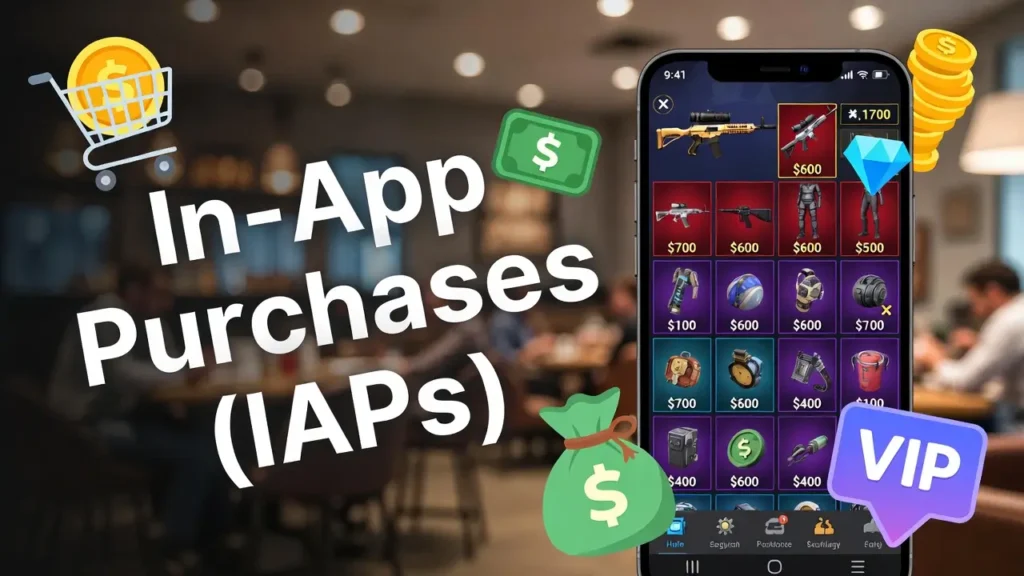
What Are In-App Purchases?
In-app purchases (IAPs) are microtransactions that allow players to buy digital goods or services directly within a game’s interface. While the game itself may be free to download (Free-to-Play or F2P), IAPs transform it into a robust marketplace. This model has shifted the industry from “selling a product once” to “monetizing a service continuously.”
To understand IAPs effectively, it is crucial to categorize them into three distinct types:
Subscriptions: A recurring revenue model, often seen as “Battle Passes” or “VIP Memberships,” giving players premium access for a set period.
Consumables: Items that are used once and disappear (e.g., extra lives, health potions, or ammunition). These drive repeat purchases.
Non-Consumables: Permanent unlocks that the player keeps forever (e.g., removing ads, unlocking a new character, or buying a level pack).
Common Purchase Categories
- Virtual Currency (Hard vs. Soft Currency): Games often use a dual-currency system. “Soft currency” (Gold/Coins) is earned by playing, while “Hard currency” (Gems/Diamonds) is bought with real money. This abstraction separates the pain of spending real money from the joy of getting an in-game item.
- Power-ups & Time-Savers: These sell convenience. Players pay to skip wait times (e.g., building construction timers) or to instantly revive, effectively trading money to save time.
- Cosmetics & “Skins”: Purely visual upgrades that do not affect gameplay stats. These rely on social signaling—players buy them to express identity or status to other players.
- Gacha Mechanics (Loot Boxes): A randomized mechanic where players pay for a chance to get a rare item. This is highly lucrative but requires careful ethical implementation due to its similarity to gambling.
| The Pros | The Cons |
| Uncapped Revenue: Unlike a $60 premium game, a dedicated “Whale” can spend thousands over the game’s lifespan. | “Pay-to-Win” Risk: Selling items that give a competitive advantage will quickly ruin your game’s reputation. |
| Funds LiveOps: Continuous revenue pays for server costs, new content, and the “Games as a Service” (GaaS) model. | Whale Dependency: Your entire business model relies on keeping a tiny 2–5% minority of your players happy. |
| Deepens Commitment: The “sunk cost” effect means players who buy even a $1.99 starter pack are more likely to stick around. | Technical Friction: Requires complex backend systems for inventory, secure payments, and handling refunds. |
3. Premium (Paid) Games
What Is a Premium Game Model?
In the Premium model (often called “Pay-to-Play”), users pay a single upfront fee to purchase the full game. Unlike the “Freemium” economy, the core value proposition here is a complete, uninterrupted experience. While traditional premium games avoid ads and microtransactions entirely, the modern definition has evolved. Many premium titles now support their long-term development through paid DLC (Downloadable Content) or major expansion packs, creating a hybrid revenue stream.
Platforms like Steam, GOG, PlayStation Store, and Nintendo eShop are the primary ecosystems for this model, where the “storefront” acts as the main marketing vehicle.
When Premium Works Best
From a market perspective, the Premium model succeeds when the game offers an experience that cannot be interrupted:
- Immersive Storytelling: Narrative-driven games (like RPGs or Horror) rely on immersion. Pausing the game to show an ad would ruin the atmosphere, making a one-time purchase the only viable option.
- Niche & Hardcore Genres: Complex strategy games or simulators often target a specific, dedicated audience. These players prefer to pay $20–$40 upfront for a deep, quality experience rather than being “nickeled and dimed” by microtransactions.
- The “Prestige” Factor: A price tag signals quality. For many PC and console gamers, a free price tag can sometimes signal “low quality” or “pay-to-win,” whereas a premium price suggests a polished, finished product.
| The Pros | The Cons |
| Uncompromised Design: Freed from forced monetization loops, grind, or paywalls, allowing for a pure, player-first experience. | High Acquisition Friction: An upfront price tag is a massive barrier to entry, requiring top-tier marketing to convince players to buy. |
| Perceived Value & Trust: A price tag signals a high-quality, “finished” product, which helps attract a dedicated and loyal audience. | Capped Revenue Ceiling: Unlike F2P “whales,” your earnings per user are strictly limited to the base price unless you release paid DLC. |
| Predictable Revenue: Financial forecasting is much easier when every single download guarantees a fixed, stable income. | Zero Bug Tolerance: Paying customers demand polish; early bugs often lead to immediate refunds (e.g., Steam’s 2-hour window) and harsh reviews. |
4. Freemium Model (Free + Paid Upgrades)
How Freemium Works
The Freemium model allows players to download a game for free but locks advanced features, levels, or the complete experience behind a one-time or optional payment. By blending free access with premium upgrades, developers allow users to experience the game’s core value before asking them to open their wallets.
Based on industry research, freemium games often convert better than strictly premium titles because players can “try before they buy,” removing the initial purchase friction while still allowing developers to monetize dedicated fans.
Common Freemium Upgrades:
Full Game Unlock: Offering the first few levels or chapters for free, then charging a one-time fee to access the rest of the game.
Ad Removal: A popular one-time purchase that permanently removes disruptive in-game advertising, drastically improving the player’s User Experience (UX).
Extra Levels or Modes: Gating “hardcore” difficulties, expansion packs, or bonus post-game content behind a paywall for your most engaged players.
| The Pros | The Cons |
| Low Barrier to Entry: Just like F2P, removing the initial price tag drastically boosts your download numbers and user acquisition. | Thoughtful Gating Required: Finding the exact point to place the paywall is difficult; too early and players churn, too late and they won’t pay. |
| Higher Conversion Rates: Letting players experience the fun firsthand makes them significantly more willing to pay for the rest of the content. | Strong Onboarding Needed: The free portion must hook the player instantly to convince them the premium upgrade is worth their money. |
| Flexible Pricing Options: Developers can offer various tiers (e.g., $1.99 to remove ads, or $9.99 to unlock the entire game and all modes). | The “Demo” Perception: Players might leave negative reviews if they feel “tricked” into downloading what is essentially a trial rather than a full free game. |
5. Subscription-Based Monetization
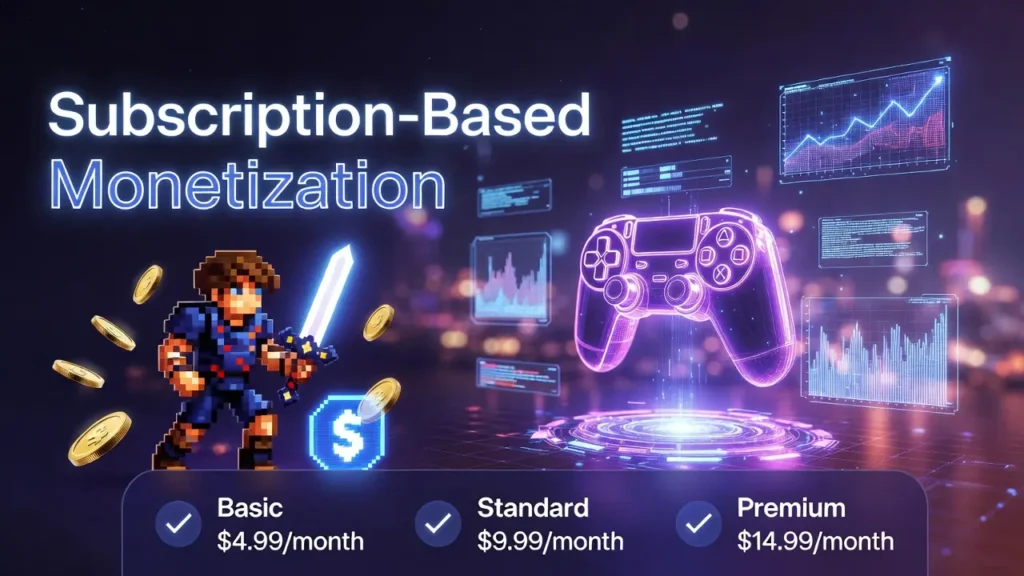
What Is a Game Subscription?
Subscriptions offer players recurring benefits, premium access, or exclusive content for a monthly or seasonal fee. This model is exceptionally popular in multiplayer and “live-service” games because it shifts monetization from unpredictable impulse purchases to a steady, reliable rhythm.
Industry trends show that subscriptions are rapidly growing because they provide predictable, stable income. For developers, this financial stability is invaluable, as it allows for confident long-term planning and budgeting for future game development.
Common Subscription Types:
Battle Passes: A seasonal, tiered progression system where players pay to unlock a premium reward track as they play (highly popular in shooters and battle royales).
VIP Memberships: A monthly fee that grants ongoing perks, such as daily premium currency payouts, XP boosts, or exclusive cosmetic badges.
Monthly Reward Packs: Curated drops of digital goods, consumables, or exclusive items delivered to the player’s inbox every month they remain subscribed.
| The Pros | The Cons |
| Recurring Revenue: Provides a predictable, stable baseline of income that is far easier to forecast than ad revenue or one-off IAPs. | The Content Treadmill: Demands constant, high-quality updates. If you stop producing fresh content, players will instantly cancel. |
| Strong Player Retention: Players who pay for a subscription (especially a Battle Pass) log in daily to ensure they get their money’s worth. | Churn Risk on Value Drop: If a specific season or month’s rewards feel “weak” or uninspired, expect a massive spike in uninstalls and cancellations. |
| Funds Ongoing LiveOps: The steady cash flow directly funds the server costs, community management, and development needed to keep a game alive. | Player Fatigue: The market is crowded. Asking players to add another gaming subscription to their monthly bills is becoming an increasingly hard sell. |
6. Esports, Tournaments, and Competitive Gaming
Competitive Monetization Explained
Competitive monetization leverages the high-stakes, skill-based nature of multiplayer games to generate revenue far beyond traditional ads or IAPs. This model is ideal for games with a high skill ceiling and strong spectator appeal, effectively turning the gameplay ecosystem into a digital sport.
As the community grows, developers can tap into entirely new revenue streams that revolve around professional play, high-level streaming, and community-driven events.
Top Revenue Opportunities:
Tournament Entry Fees: Hosting official, online paid tournaments where players pay a small entry fee (in real money or premium currency) to compete for a prize pool.
Sponsorships & Brand Deals: Partnering with brands to feature their logos natively within the game arena or during official competitive broadcasts.
Streaming Rights & Media: Monetizing the broadcast of high-level play, championships, and community-run competitions on platforms like Twitch or YouTube.
Merchandise Sales: Selling physical apparel, collectibles, and gear tied to the game’s competitive scene or specific esports teams.
| The Pros | The Cons |
| Builds Strong Communities: Fosters a deeply dedicated, highly engaged player base driven by skill, rivalry, and social connection. | Difficult to Scale Initially: Building a competitive scene from scratch requires a massive, active player base just to get started. |
| High Brand Visibility: Tournaments and live streaming naturally act as massive, free marketing engines that draw in new players constantly. | Strict Anti-Cheat Required: Competitive integrity is everything; a single major cheating scandal can instantly destroy the game’s reputation. |
| Long-Term Ecosystem Growth: A thriving, well-managed competitive scene can keep a game relevant and highly profitable for over a decade. | High Operational Costs: Organizing events, managing broadcasts, and funding initial prize pools require significant upfront investment. |
7. Merchandising, Licensing, and Brand Collaborations
Beyond the Game: Brand Expansion
Successful games eventually outgrow their digital borders, monetizing outside the app itself through merchandising, licensing, and brand collaborations. This model transforms a successful piece of software into a full-fledged intellectual property (IP) and entertainment franchise.
From an industry perspective, this route is highly lucrative but only makes sense under specific conditions. To succeed here, a game needs deeply iconic characters, a highly recognizable brand identity, and a loyal fanbase eager to represent the game in the real world.
Top Brand Expansion Strategies:
Physical Merchandise: Selling tangible goods like t-shirts, plush toys, posters, and high-end collectibles directly to your most passionate players.
Brand Partnerships (Crossovers): Collaborating with non-gaming brands (like apparel companies, energy drinks, or hardware makers) for mutual cross-promotion and limited-edition drops.
IP Licensing: Leasing the rights to your game’s characters or world to other entertainment companies to create comic books, board games, or even animated series.
| The Pros | The Cons |
| Diversified Income: Creates revenue streams completely independent of volatile app store ecosystems, ad networks, or platform fees (Apple/Google’s 30% cut). | Complex Logistics: Managing physical manufacturing, global shipping, inventory, and customer service is an entirely different business from coding a game. |
| Strengthens Brand Loyalty: Physical items turn players into walking billboards, deepening their emotional connection and real-world investment in the IP. | High Barrier to Entry: This model simply does not work for small indie titles; it requires massive scale and cultural relevance to generate real-world demand. |
| Cultural Longevity: Expanding into merchandise and cross-media adaptations keeps the game culturally relevant even when players aren’t actively logging in. | Quality Control Risks: If a licensed partner produces cheap, low-quality merchandise or rushed media, it can severely damage your game’s reputation. |
Costly Game Monetization Mistakes to Avoid
Before concluding, it is critical to highlight common mistakes:
- Overloading games with ads
- Pay-to-win mechanics that hurt trust
- Ignoring player feedback
- Monetizing too early without engagement
- Not localizing pricing for global markets
Conclusion: Choosing the Right Monetization Strategy
As we have explored in this 2026 guide, there is no single “magic bullet” for monetization. The most successful developers do not force a model that doesn’t fit; instead, they mix and match strategies based on their specific audience, platform, and game genre.
In our opinion, the future of profitability lies in Hybrid Monetization. By combining multiple revenue streams, you protect your business from market volatility while giving players the flexibility to support you in the way they prefer.
For example:
- Casual mobile games → Ads + IAPs
- Story-based PC games → Premium pricing
- Multiplayer games → Subscriptions + cosmetics
Ultimately, the key to sustainable revenue is balance. Monetization should never come at the cost of the user experience. When implemented correctly, it feels like a fair exchange of value—enhancing the game rather than interrupting it. Treat your players with respect, and they will reward you with their loyalty.
Frequently Asked Questions (FAQs)
1. What is the best game monetization method in 2026?
There is no universal best method. Ads and IAPs dominate mobile, while premium and subscriptions perform better on PC and console.
2. Can indie developers monetize games successfully?
Yes. Many indie developers succeed using freemium, premium, or niche subscription models.
3. Do ads reduce player retention?
Poorly implemented ads do. Rewarded ads, however, often improve retention.
4. Is game monetization allowed under Google AdSense policies?
Yes, as long as ads and content comply with AdSense guidelines.
5. Should I use multiple monetization models?
In most cases, yes—but only if they complement each other and respect user experience.
6. What is a hybrid monetization model?
A hybrid model combines multiple revenue streams, such as pairing in-app purchases with rewarded ads, to monetize both paying and non-paying players.
7. How can I avoid making my game “Pay-to-Win” (P2W)?
Focus your real-money purchases strictly on cosmetic items or convenience, never on stats or weapons that offer a competitive advantage in gameplay.
8. Why is LiveOps critical for modern games?
LiveOps keeps players engaged long-term through regular content updates and seasonal events, creating a steady and predictable revenue stream.